Showing posts with label education. Show all posts

Thursday, December 4, 2025

AI in K-12 Schools: The genie, the bottle, and the future.

 As both (a) an Instructional Designer who cut his teeth on leveraging (early) AI to improve education/training and (b) the spouse of a teacher in our local school district, each day I am confronted with stories from the news outlets and tales from the frontlines about the promises and perils of AI for students and teachers.

The recent announcement by OpenAI that they will provide K-12 teachers access to a free version of their flagship ChatGPT product has reignited my dual excitement and reservations about how this new technology can vs. should be adopted in schools.

I know myself well enough to resist the siren call of quickly aligning with either end of the "utopia/doomsday" spectrum in exchange for a purposeful and thoughtful "pause" while critically entertaining arguments from all sides. I've long been a believer in Amara's Law (new technologies are overestimated in the short-term and underestimated in the long-term) and feel that AI is a strong case example, but I'll admit the pace this technology is advancing is unlike anything I've seen (including the internet/WWW). This breakneck speed of product and version releases may present a (semi) unique challenge to the benefits of slowing down to contemplate/debate/weigh the pros and cons we are confronting. There may be a real risk of slipping into extended philosophical discussions about whether the light in the tunnel is a new vista of opportunity or an oncoming train as we speed towards the tunnel's opening and we are forced to live with the ramifications of our (hasty?) decision.

I also recognize how it may not be fair to frame this as a binary fork in the road - there may be several shades of gray that are available for society between the black/white extremes. Perhaps we can learn from past predictions of the impact of previous technologies (radio, television, calculators, computers, the internet, etc.) on education, and reflect on the hindsight true impact they provided, both positive and negative? Very few advances can honestly be seen as "silver bullets" with no downsides, so it may be a matter of thoughtfully identifying what is gained vs. lost with each new offering and deciding if the benefits outweigh the costs.

Similarly, however, there is value in being realistic and pragmatic about how it's difficult (impossible?) to "put the genie back in the bottle" once it has been released (think: the atomic bomb, for instance). AI, in some form, is here to stay and our grand/children will never know a world without it. We cannot afford to wistfully lament about "the good ol' days"; we must actively engage with the knotty issues AI presents us and not allow others (tech companies, government representatives, academics) to dictate a future we simply must passively accept.

I fully enjoy reading the various perspectives that are shared on LI (see: Gary Stager, Ph.D. and Chris Riesbeck as but two examples) but I also think it's important to include the voices of "the common wo/man" in the debate. PBS recently had a thought-provoking story on this topic that included thoughts from a variety of perspectives, ranging from an MIT professor to everyday parents. I encourage watching the short clip.

Please share YOUR thoughts on where your instincts are leaning, why, and what sorts of practical steps can be taken to inject thoughtful and inclusive debate to balance the rocket ship AI has become in our lives (educational and otherwise)!

Thanks for your willingness to share your wisdom with the crowd...

Tuesday, December 3, 2013

Sir Ken Robinson - The Swinging Pendulum of Ed Reform

Recently, in the TAG Workplace Learning Society group on LinkedIn, there was a posting of the famous TED Talk that Sir Ken Robinson gave in mid-2006.  A question was posed about how much in the educational world had (not) changed in the 7 years that have passed, and how people generally felt about the talk, in hindsight ("...do you think Sir Kenneth Robinson is having an impact other than making smart people laugh?").


I recall viewing Sir Ken's TED Talk shortly after it was originally posted in mid-2006 and hurriedly passing the link on to just about everyone on my contact list.  It was a breath of fresh air and it caught my attention and imagination.  Given that it's been viewed 20.3 million times (on TED's site alone - likely several multiples higher when considering other hosts, like YouTube), I wasn't alone with the excitement I felt and hopes that it might be a tipping point of change.

As with most things, there is always a ying to one's yang, and since Robinson has become an Ed Reform poster child (man?) there have been a few critics that have emerged.  I always like to listen and consider alternative viewpoints so I don't fall into the modern trap of a confirmational echo chamber, so you may find something of interest in one/both of the following randomly selected blog entries:

http://edtechnow.net/2012/01/20/sir-ken-robinson/
http://edtechnow.net/guest-posts/ken-robinson-rebuttal/

I share these alternative views to promote healthy conversation and appreciation of the complexity and nuances of the issue at hand.  Educational reform is a politically, logistically, and emotionally charged topic that cannot be 'fixed' with a few tweaks and adjustments.  I still like Robinson's talk very much, but time has mellowed my thinking a bit...

Do I think the overall message Robinson has called attention to is on the mark?  Yes.  I don't think there are many defenders of the status quo in terms of today's educational practices.  Do I think the critics have some interestingly valid points? Again, yes.  But I'm not sure that's a bad thing....

I think that Robinson may be taking the same approach that the Head of my grad school program (The Institute for the Learning Sciences), Dr. Roger Schank, adopted.  That is - say some things that are a bit extreme but have enough truth in them to get people to pause and think.  It's only after you get people's attention with the exaggerated claims ("all schools should be burned down") that critical thought and consideration is evoked, which leads to what (I believe) his real goal is - serious thought about how we can do better in education.  He isn't actually seeking people to line up and agree with him lock/stock/barrel (he openly says even he doesn't agree with some of the things he's said!) - he is a catalyst who makes claims towards the extreme end of the spectrum in order to get people to engage in discussions that are more mainstream.

(You can get a feel for Schank's positions and personality via:
(1) a video intro (http://youtu.be/7cG4EwmvUHc) to Engines for Education (http://www.engines4ed.org/hyperbook/), a free "hyperbook" that I help get on the Internet back in the dark ages of the Web, or
(2) his blog, Education Outrage (http://educationoutrage.blogspot.com/).)

I agree that change can feel frustratingly slow in these times of instant everything, but considering how long the current system has been in place and how many supporting structures have been created to prevent change, reform efforts may actually be moving at a faster rate than one might expect.  It's pretty amazing that there are currently several working examples of MOOCs (warts and all) available to the curious masses for free, when MIT's OpenCourseWare initiative was launched barely a decade ago.  Systems of higher education that were centuries in the making are now teetering on the edge of pretty dramatic change, largely because of advances in technology and the ability of the market to accelerate the pace of change with their wallets and feet.

The K-12 world is less 'market-driven' (for better or worse, depending on your viewpoint), so the pace of change lags a bit, but the options available to parents and children for alternative programs that 'foster creativity and independent thought' (as Leigh Anne Lankford said), focus on less common subjects, or allow for a competency-driven instead of age-driven path through curricula is astoundingly greater than just a few years ago.

Educational change is inevitable, but we should not/cannot rest on that undeniable truth.  Work remains.

As Sci-Fi author William Gibson said, "The future is already here - it's just not evenly distributed."

Friday, June 21, 2013

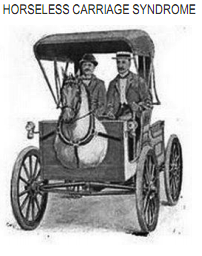
The Irrelevance of Educational Horseless Carriages

A few weeks ago, a meme popped up within the Education community that put me a little on my heels, forcing me to reconsider the 'educational reform' question from an entirely different perspective.  I've been trying to noodle on my thoughts about it, but didn't want to postpone getting a posting up for too long, so...

The crux of the question/argument is grounded in the (quite common, these days) rant that the current (US) educational system is "broken" and the highest order attention should be invested in "fixing" it.

What if this perspective is well intended, but misguided?
What if the current educational system is actually awesome - arguably near perfect - at achieving its intended goals?
What if it'd be more productive to cease trying to "fix" it, but rather simply recognize what it was original designed to do and stop considering it to be some timeless 'silver bullet' to address society's ever changing needs?

What if the current educational systems isn't "broken" but is simply "irrelevant" (as Heather Hiles puts it)?

The current model was created for a variety of reasons, most of which were quasi-legitimate at the time (an Industrial Age demand for lots of similarly skilled/thinking workers to fuel the new demand for mass-produced goods may be the primary one.  See Roger Schank's "Making Minds Less Educated Than Our Own" for a deeper dig on why we are taught what we are taught).  But we are living in dramatically different times now, so wouldn't it naturally follow that the goals/objectives of a system of education from yesteryear may no longer apply?

When the car first came out, many had a predictably hard time getting their heads around what sort of change it represented.  According to a Microsoft whitepaper, it is said that banks held the position that "The horse is here to stay but the automobile is only a novelty, a fad." and that even automobile inventor Daimler predicted that the long-term market opportunity was limited to ~1 million cars due to their cost and the shortage of capable chauffeurs.  For a short period of time, people tried to "fix" horse-drawn carriages to accommodate for this new transportation development, even to the point of mounting horse whip holders on the sides of the new 'horseless carriages'.

Perhaps we are clinging to the old and familiar models of education simply because they are that - old and familiar?  With the advent of online learning, is there really any reason to move children through an age-based, cattle-call, lock-step process (treating them like widgets on an assembly line whose most important defining characteristic is their date of manufacture (nod to Sir Ken Robinson))?  Does the modern marketplace (primarily) require that schools produce millions of workers who are obedient, able to follow instruction, and not 'ask questions' because the answers have already been determined?  Are we still ruled by the supply and demand limitations of expert and novice ratios that prompted the 'efficiency' of the 'little red schoolhouse' (and its current day equivalents)?

Modern day demands and skills require modern day educational options and processes.  Our time, money, and intellectual/creative resources may be best leveraged by giving up on trying to 'band-aid' a philosophy that simply doesn't apply any longer and (re)focusing on new vistas of opportunity.

Are we creating the educational equivalent of rotary phones with touch-tone buttons or bluetooth earpieces for smartphones?


Wednesday, May 15, 2013

TftD #18

As children get older, schools progressively focus more and more above the waist… above the neck… slightly to one side.

--Sir Ken Robinson

Wednesday, May 8, 2013

TftD #17

Our children grow up in a culture permeated with the idea that there are "smart people" and "dumb people". The social construction of the individual is as a bundle of aptitudes. There are people who are "good at math" and people who "can't do math". Everything is set up for children to attribute their first unsuccessful or unpleasant learning experiences to their own disabilities. ... Within this framework children will define themselves in terms of their limitations, and this definition will be consolidated throughout their lives. Only rarely does some exceptional event lead people to reorganize their intellectual self-image in such a way as to open up new perspectives on what is learnable. 

-- Seymour Papert: Mindstorms (pg 43)

Saturday, February 23, 2013

TftD #13

Why is it that in spite of the fact that teaching by pouring in, and learning by passive absorption, are universally condemned, (educators) are still so entrenched in its practice?

Education is not an affair of 'telling' and being told, but an active constructive process.

-- John Dewey, Democracy and Education (1916)