A few weeks ago, a meme popped up within the Education community that put me a little on my heels, forcing me to reconsider the 'educational reform' question from an entirely different perspective. I've been trying to noodle on my thoughts about it, but didn't want to postpone getting a posting up for too long, so...
The crux of the question/argument is grounded in the (quite common, these days) rant that the current (US) educational system is "broken" and the highest order attention should be invested in "fixing" it.
What if this perspective is well intended, but misguided?
What if the current educational system is actually awesome - arguably near perfect - at achieving its intended goals?
What if it'd be more productive to cease trying to "fix" it, but rather simply recognize what it was original designed to do and stop considering it to be some timeless 'silver bullet' to address society's ever changing needs?
What if the current educational systems isn't "broken" but is simply "irrelevant" (as Heather Hiles puts it)?
The current model was created for a variety of reasons, most of which were quasi-legitimate at the time (an Industrial Age demand for lots of similarly skilled/thinking workers to fuel the new demand for mass-produced goods may be the primary one. See Roger Schank's "Making Minds Less Educated Than Our Own" for a deeper dig on why we are taught what we are taught). But we are living in dramatically different times now, so wouldn't it naturally follow that the goals/objectives of a system of education from yesteryear may no longer apply?
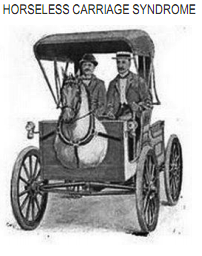
When the car first came out, many had a predictably hard time getting their heads around what sort of change it represented. According to a Microsoft whitepaper, it is said that banks held the position that "The horse is here to stay but the automobile is only a novelty, a fad." and that even automobile inventor Daimler predicted that the long-term market opportunity was limited to ~1 million cars due to their cost and the shortage of capable chauffeurs. For a short period of time, people tried to "fix" horse-drawn carriages to accommodate for this new transportation development, even to the point of mounting horse whip holders on the sides of the new 'horseless carriages'.
Perhaps we are clinging to the old and familiar models of education simply because they are that - old and familiar? With the advent of online learning, is there really any reason to move children through an age-based, cattle-call, lock-step process (treating them like widgets on an assembly line whose most important defining characteristic is their date of manufacture (nod to Sir Ken Robinson))? Does the modern marketplace (primarily) require that schools produce millions of workers who are obedient, able to follow instruction, and not 'ask questions' because the answers have already been determined? Are we still ruled by the supply and demand limitations of expert and novice ratios that prompted the 'efficiency' of the 'little red schoolhouse' (and its current day equivalents)?
Modern day demands and skills require modern day educational options and processes. Our time, money, and intellectual/creative resources may be best leveraged by giving up on trying to 'band-aid' a philosophy that simply doesn't apply any longer and (re)focusing on new vistas of opportunity.
Are we creating the educational equivalent of rotary phones with touch-tone buttons or bluetooth earpieces for smartphones?
An occasional outlet for thoughts on eLearning, Knowledge, Stories/Narratives, and anything else that comes to mind.
Friday, June 21, 2013
Tuesday, May 21, 2013
TftD #19
Everyone is a genius. But if you judge a fish by its ability to climb a tree, it will live its whole life believing it's stupid.
--Albert Einstein
--Albert Einstein
Friday, May 17, 2013
PBS Superheroes Save The Future!
Who will save humanity from "...brain-shrinking reality TV and watch the world...LEARN!"?
It's the "PBS Avengers" - Carl Sagan, Mister Rogers, Bill Nye (the Science Guy), and Bob Ross!
We should only be so lucky....
It's the "PBS Avengers" - Carl Sagan, Mister Rogers, Bill Nye (the Science Guy), and Bob Ross!
We should only be so lucky....
Wednesday, May 15, 2013
TftD #18
As children get older, schools progressively focus more and more above the waist… above the neck… slightly to one side.
--Sir Ken Robinson
--Sir Ken Robinson
Wednesday, May 8, 2013
TftD #17
Our children grow up in a culture permeated with the idea that there are "smart people" and "dumb people". The social construction of the individual is as a bundle of aptitudes. There are people who are "good at math" and people who "can't do math". Everything is set up for children to attribute their first unsuccessful or unpleasant learning experiences to their own disabilities. ... Within this framework children will define themselves in terms of their limitations, and this definition will be consolidated throughout their lives. Only rarely does some exceptional event lead people to reorganize their intellectual self-image in such a way as to open up new perspectives on what is learnable.
-- Seymour Papert: Mindstorms (pg 43)
Sunday, April 21, 2013
Louis C.K. on Creative Work
An interesting bit on the value of struggle during the creative process from comedian Louis C.K. (from the 4/25/13 Rolling Stone):
"When it's time to write, I have one computer that has no ability to get on the Internet. Because the ability to just move your finger less than a millimeter and be looking straight into someone's #*$^ or at a new Porsche, or a whole movie - To Kill a Mockingbird, let's just sit here and watch the whole thing! - it's too much. So if you put a couple of moves between you and that, you've got a fighting chance.
When I hit a stopping moment in what I'm writing, a moment of agitation - that itch always leads to a brand new thing, to inspiration. But if you bail out and buy a product online, you're robbing yourself. It's terrible, so I sit there: "F*ck, f*ck." The worst thing happening to this generation is that they're taking discomfort away from themselves."
Wednesday, April 3, 2013
Lawrence Lessig's Grand Plan to Recover the Republic
Lawrence Lessig does it again with a stunningly compelling call to arms for fixing the growing issues within our government that simply cannot be ignored and must be reformed.
Crazy facts (3:00) :
Something's gotta give...
Hard? Perhaps. But what's the alternative?
(then again, maybe it's not so tough... "a single statute... for small dollar-funded elections" (11:30))
Crazy facts (3:00) :
- .26% of American gave $200 or more to any federal candidate.
- .05% gave the maximum amount to any federal candidate.
- .01% (1% of the 1%) gave $10,000 or more to federal candidates.
- In the last election cycle, .000042% (that's 132 Americans) gave 60% of the Super PAC money spent.
Something's gotta give...
Hard? Perhaps. But what's the alternative?
(then again, maybe it's not so tough... "a single statute... for small dollar-funded elections" (11:30))
Subscribe to:
Posts (Atom)


