A few weeks ago, a
meme popped up within the Education community that put me a little on my heels, forcing me to reconsider the 'educational reform' question from an entirely different perspective. I've been trying to noodle on my thoughts about it, but didn't want to postpone getting a posting up for too long, so...
The crux of the question/argument is grounded in the (quite common, these days) rant that the current (US) educational system is "broken" and the highest order attention should be invested in "fixing" it.
What if this perspective is well intended, but misguided?
What if the current educational system is actually awesome - arguably near perfect - at achieving its intended goals?
What if it'd be more productive to cease trying to "fix" it, but rather simply recognize what it was original designed to do and stop considering it to be some timeless 'silver bullet' to address society's ever changing needs?
What if the current educational systems isn't "
broken" but is simply "
irrelevant" (as
Heather Hiles puts it)?
The current model was created for a variety of reasons, most of which were quasi-legitimate at the time (an Industrial Age demand for lots of similarly skilled/thinking workers to fuel the new demand for mass-produced goods may be the primary one. See Roger Schank's "
Making Minds Less Educated Than Our Own" for a deeper dig on why we are taught what we are taught). But we are living in dramatically different times now, so wouldn't it naturally follow that the goals/objectives of a system of education from yesteryear may no longer apply?
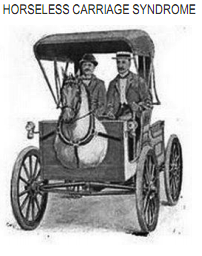
When the car first came out, many had a predictably hard time getting their heads around what sort of change it represented. According to a
Microsoft whitepaper, it is said that banks held the position that "
The horse is here to stay but the automobile is only a novelty, a fad." and that even automobile inventor Daimler predicted that the long-term market opportunity was limited to ~1 million cars due to their cost and
the shortage of capable chauffeurs. For a short period of time, people tried to "fix" horse-drawn carriages to accommodate for this new transportation development, even to the point of mounting horse whip holders on the sides of the new 'horseless carriages'.
Perhaps we are clinging to the old and familiar models of education simply because they are that - old and familiar? With the advent of online learning, is there really any reason to move children through an age-based, cattle-call, lock-step process (treating them like widgets on an assembly line whose most important defining characteristic is their date of manufacture (nod to
Sir Ken Robinson))? Does the modern marketplace (primarily) require that schools produce millions of workers who are obedient, able to follow instruction, and not 'ask questions' because the answers have already been determined? Are we still ruled by the supply and demand limitations of expert and novice ratios that prompted the 'efficiency' of the 'little red schoolhouse' (and its current day equivalents)?
Modern day demands and skills require modern day educational options and processes. Our time, money, and intellectual/creative resources may be best leveraged by giving up on trying to 'band-aid' a philosophy that simply doesn't apply any longer and (re)focusing on new vistas of opportunity.
Are we creating the educational equivalent of rotary phones with touch-tone buttons or bluetooth earpieces for smartphones?